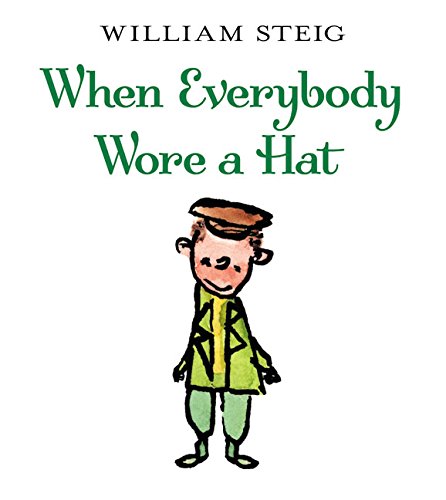
This is the story of when I was a boy, almost 100 years ago, when fire engines were pulled by horses, boys did not play with girls, kids went to libraries for books, there was no TV, you could see a movie for a nickel, and everybody wore a hat. Grade 1 Up-In 1916, Steig was eight years old. This autobiography describes that year of his life. The somewhat disjointed recollections are recounted in a stream-of-consciousness style and will evoke nostalgia in adults and surprise in children-fire engines pulled by horses, five-cent movies and hot dogs, no TV, a wind-up phonograph. Like elementary school drawings taped to the refrigerator, the childlike, watercolor artwork that accompanies the memories features flattened tables, nostrils on the sides of noses, and a sidewalk extending up into the air. Yet the illustrations' navet belies their underlying sophistication. With a few spare lines, the artist manages to convey body language, facial expression, and gesture. For example, the picture of young Steig clinging to his sister as his parents fight is poignant; the eyes may be simple dots inside ovals, but they convey worlds of information about the children's anxiety. There were upbeat times for the family as well, in spite of the ongoing World War I. Steig reveals his childhood crush, daily activities, and dreams for the future. Black-and-white photos of the author on the first and last pages (one as a child and one as he appears now) and the cover art (front and back views of a youngster in a hat) bring this reminiscence full circle. Given the subject matter and lack of plot, this book seems aimed at Steig's adult fans. Laurie Edwards, West Shore School District, Camp Hill, PA Copyright 2003 Reed Business Information, Inc. K-Gr. 3. Steig's picture-book memoir of his immigrant childhood in the Bronx nearly 100 years ago may appeal more to adults than to kids, but as always with this master artist, there's no wistful nostalgia. The words are spare, just a line on each page. The wonderfully expressive, full-page pictures, with thick black lines and bright watercolors in shades of green and red, bring the past right here, with a wry, visceral sense of the kid's viewpoint. The adults are ridiculous (including the overdressed women with their corsets and heels and hats, "sometimes with fruit") or sad (the boy watching helplessly while his mother weeps about sad news from the Old Country), always distant. Steig remembers the longing for privacy ("it was impossible to be alone"). And yes, there was a war on-- World War I. The hats are of the times, but the experience of the small child in a world of overpowering and weird grown-ups hasn't changed. Hazel Rochman Copyright © American Library Association. All rights reserved William Steig's drawings appeared regularly in The New Yorker since 1930. He also wrote and illustrated books for children, most recently his memoir, When Everybody Wore a Hat . His other books include Sylvester and the Magic Pebble, winner of the Caldecott Medal; The Amazing Bone, a Caldecott Honor Book; and Abel's Island and Doctor De Soto, both Newbery Honor Books; Doctor De Soto Goes to Africa ; Pete's A Pizza ; and Zeke Pippin .