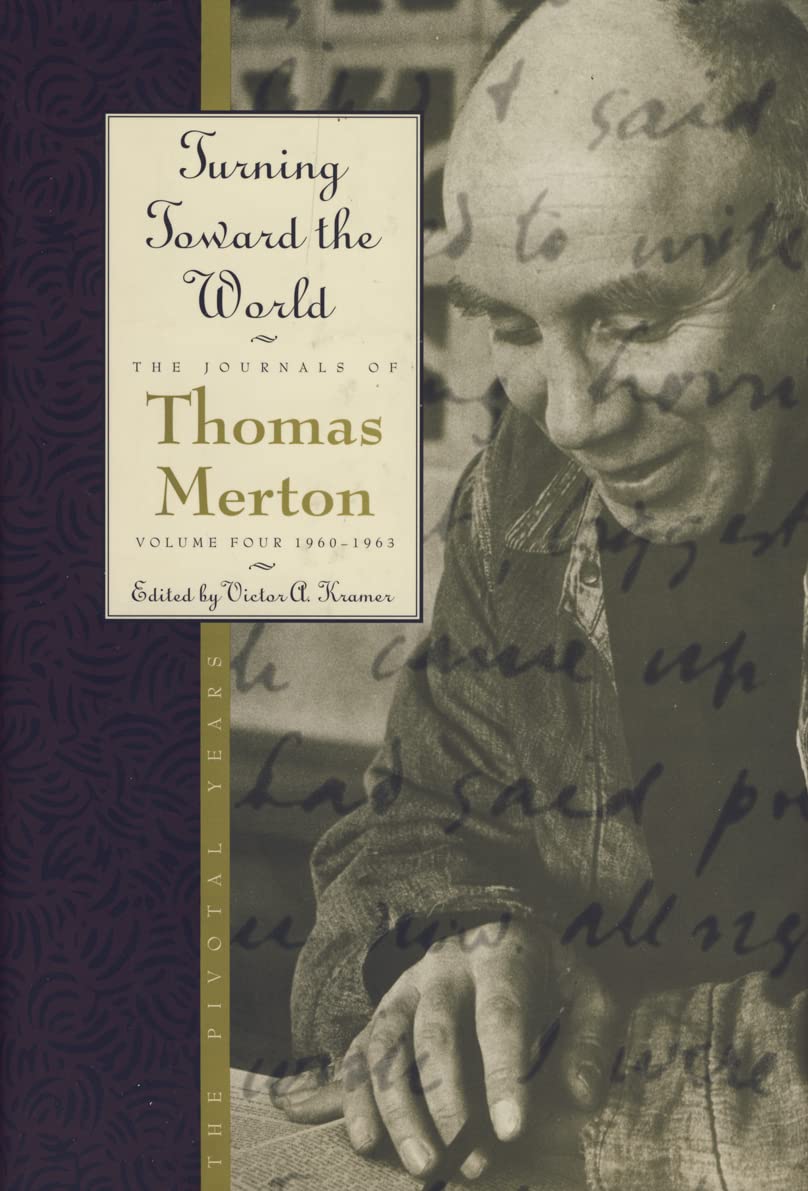
The fourth volume of Thomas Merton's complete journals, one of his final literary legacies, springs from three hundred handwritten pages that capture - in candid, lively, deeply revealing passages - the growing unrest of the 1960s, which Merton witnessed within himself as plainly as in the changing culture around him. In these decisive years, 1960-1963, Merton, now in his late forties and frequently working in a new hermitage at the Abbey of Gethsemani, finds himself struggling between his longing for a private, spiritual life and the irresistible pull of social concerns. Precisely when he longs for more solitude, and convinces himself he should cut back on his writing, Merton begins asking complex questions about contemporary culture ("the 'world' with its funny pants, of which I do not know the name, its sandals and sunglasses"), war, and the Church's role in society. Thus, despite his resistance, he is drawn into the world where his celebrity and growing concern for social issues fuel his writings on civil rights, nonviolence, and pacifism and lead him into conflict with those who urge him to leave moral issues to bishops and theologians. Merton (1915-68), the Trappist monk and author of numerous books, published many journals, which were carefully edited and rewritten until they became theological masterpieces. Now Merton scholars have a rare opportunity to see the actual writing journals, transcribed from Merton's own handwritings. Turning Toward the World is a seven-volume set, and Volume 4 covers the period from May 1960 to July 1963, the years when Merton set up his private hermitage in the woods of the Abbey of Gethsemani. It shows a deeply troubled man attempting to reconcile his chosen solitude with his growing belief that faith must be active in the world. This incredibly rich work is full of aphorisms, comments, castigations of himself and his fellow monks, laundry lists of read books, and descriptions of the weather. For the uninitiated, this journal will be tedious and slow-going; however, for Merton scholars, there is no better source for both pleasure and intellectual stimulation. Volume 4 turns the soil from which much of Conjectures of a Guilty Bystander (1966) grew. Recommended for academic libraries.?Glenn Masuchika, Chaminade Univ. Lib., Honolulu Copyright 1996 Reed Business Information, Inc. Like the first three volumes of Merton's journals, this is a treasure, full of insight into the development of his work and the intellectual influences that contributed to it. These journals offer remarkable insight into the ripening process and the personal struggle that accompanied it. They are also full of insight into a pivotal period in world history. Merton's comments on the cold war, crises in Berlin and Cuba, the peace movement, and the direction of U.S. foreign policy are important as historical documents; but they often also exhibit a surprisingly contemporary relevance. Part of the ripening that is evident in this volume is his maturing discernment of the relationship between his monasticism and his deep concern for the affairs of the world. There is no doubt that Merton is among the most influential thinkers of the twentieth century, particularly with regard to peace and interfaith dialogue. This volume of his journals, like the first three, is an indispensable aid to understanding and deepening the influence. Steve Schroeder This volume of journals reveals Merton in his late 40s, already pulled by the tension between spiritual interiority and social activism that was to characterize his final years. By 1960 Merton was an internationally renowned figure. His bestselling Seven-Storey Mountain (1948) had been ranked alongside St. Augustine's Confessions, and in a steady stream of books and articles he had explored monastic spirituality in a way that seemed fresh and relevant to a wide public. The themes in this volume of his journals show a definite shift away from his earlier otherworldliness. Kramer (English/Georgia State Univ.) has divided the manuscript chronologically into four parts. We see Merton at last obtaining the unusual permission from his abbott at Gethsemani to live in a hermitage, yet meeting a growing number of thinkers and representatives of other faiths in his retreat. Even before Vatican II begins, he is involved in the issues of liturgical reform, ecumenism, and especially the Church's attitude to the modern world. The Cuban missile crisis and the apparent inevitability of nuclear war loom large. Merton considers the need for Christians, including himself, to speak out against the Vietnam War and social segregation, while the writings of Hannah Arendt and the Eichmann case force him to think more deeply about the Catholic understanding of obedience. These pages are characterized more by breadth than depth. Although there is much personal questioning, spiritual musing, and notes from Merton's extensive reading and worldwide correspondence, most readers would do bette