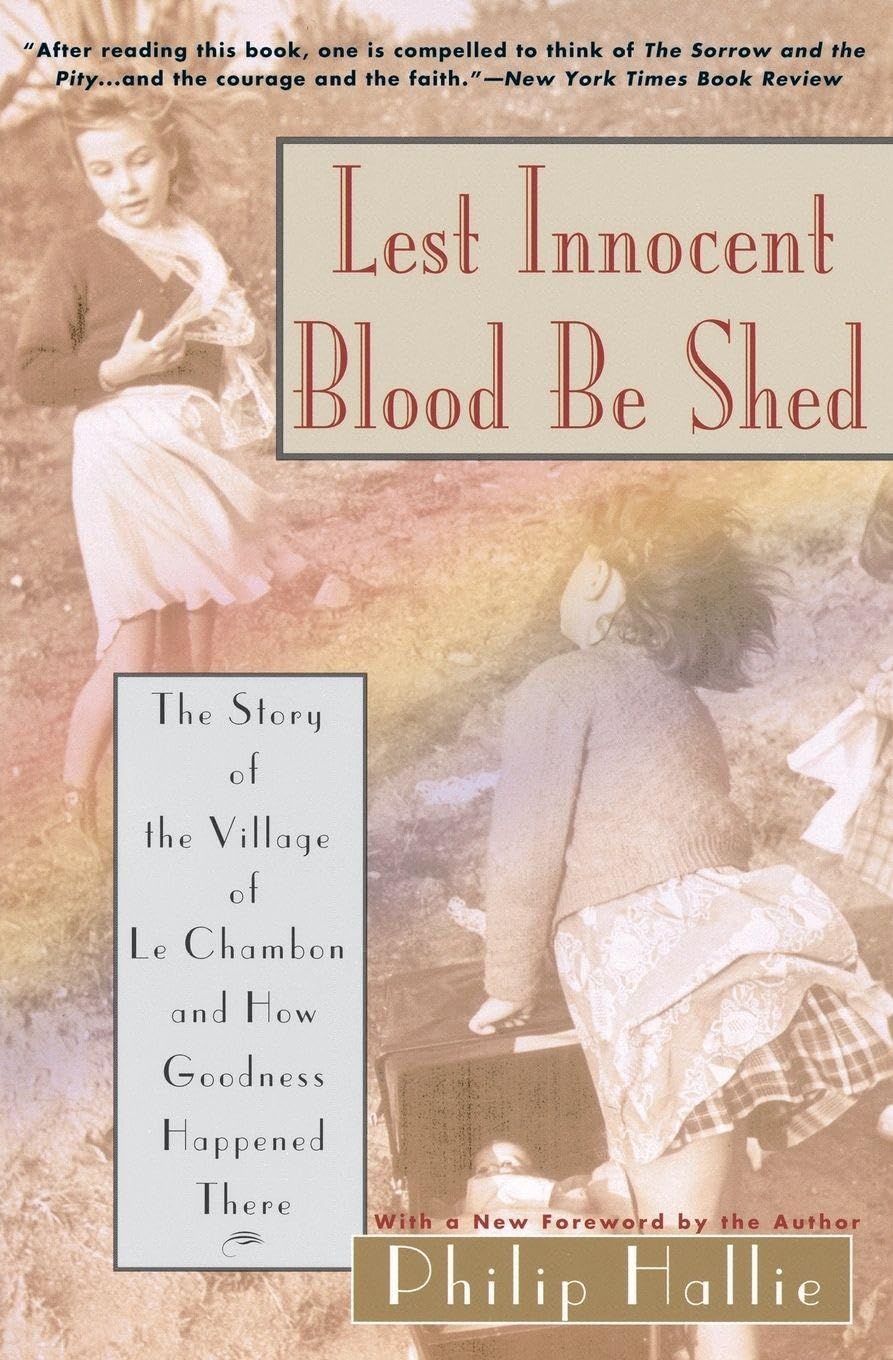
During the most terrible years of World War II, when inhumanity and political insanity held most of the world in their grip and the Nazi domination of Europe seemed irrevocable and unchallenged, a miraculous event took place in a small Protestant town in southern France called Le Chambon. There, quietly, peacefully, and in full view of the Vichy government and a nearby division of the Nazi SS, Le Chambon's villagers and their clergy organized to save thousands of Jewish children and adults from certain death. "The subject makes a deservedly beautiful book. Mr. Hallie is wholly equal to it."--Paul Horgan"The thing that makes the story of this village supremely beautiful is simply that it happened. These events took place and therefore demand place in our view of the world. If awareness of history has pushed us to the point of losing faith in ourselves, the case may also be, as professor Hallie says, that 'redemption lies in remembering.' "Lest Innocent Blood Be Shed is one of the rarest of books, the kind that can change the way we live."--"Harper's"If, as has often been alleged, our old ethics do not work well, the alternatives work worse. But what is stunning about the people of Le Chambon is that the old ethics worked perfectly for them. Its citizens attained in virtue the perfection that in artistic creation or performance we recognize as glamorous--magical, mystifying, romantic, alluring. The Chamonnais set new standards of excellence."--"The New Yorker"After reading this book, one is compelled to think of "The Sorrow and the Pity...and the courage and the faith."--"New York Times Book Review During the most terrible years of World War II, when inhumanity and political insanity held most of the world in their grip and the Nazi domination of Europe seemed irrevocable and unchallenged, a miraculous event took place in a small Protestant town in southern France called Le Chambon. There, quietly, peacefully, and in full view of the Vichy government and a nearby division of the Nazi SS, Le Chambon's villagers and their clergy organized to save thousands of Jewish children and adults from certain death. Philip Hallie was Griffin Professor of Philosophy at Wesleyan University, where he taught for thirty-two years. He died in 1994, leaving this manuscript. That it can now be published is do to the devotion of his wife, Doris Ann Hallie, who contributed an afterword. The foreword by John Compton, fellow philosopher and longtime friend of the author, will help the reader to understand this unusual document in the context of Hallie's life and thought. Lest Innocent Blood Be Shed By Hallie, Philip Perennial Copyright ©2004 Philip P. Hallie All right reserved. ISBN: 0060925175 Chapter One The Arrest of the Leaders At seven o'clock in the evening of February 13, 1943, an official black automobile stopped not far from the Protestant presbytery of Le Chambon.Automobiles--after three years of German occupation--were very rare in those days.But the car was not noticed much, partly because the street it stopped in was a secluded one, and partly, because in the last few months there had been an increase of official, especially police, activity in the village.The Germans were learning a new feeling, the feeling of danger.A few months before, the British and the Americans under the command of General Dwight D. Eisenhower had landed on the beaches of Morocco and Algeria, and Nazi North Africa was crumbling.To protect conquered France from new threat to the south, the Germans had moved their troops, their secret police, and their administrators across the demarcation line at the Loire and into southern France, where Le Chambon stood.Hitherto they had been content to stay above the Loire and on the vulnerable west coast of France, and had been content to give the French the illusion of governing themselves in the south, but now they had a southern flank to cover in Fortress Europe.Moreover, the Russians at Stalingrad had checked the momentum of the great Nazi military machine, when just a few months before that machine had seemed irresistible.And so the Germans were disturbed, and were showing their disturbance by sending their instruments, the police of Marshal Philippe Petain's Vichy government, into the quiet regions of southern France in order to threaten or arrest anyone who might abet their now dangerous enemies. Out of the car stepped two uniformed Vichy French policemen: Major Silvani, the chief of police of the department of Haute-Loire, and a lieutenant. The winter wind, la burle, was twisting and piling snow around the gray, fifteenth-century presbytery when they knocked on the door.It was a very dark night, without moon or stars, but the accumulated snow vaguely lit up the long dining room in which the minister's wife, Magda Trocme, was working.Through its three windows cut in the thick granite walls, the dim, reflected light made barely visible the sycamore and oak paneling on the ceiling a