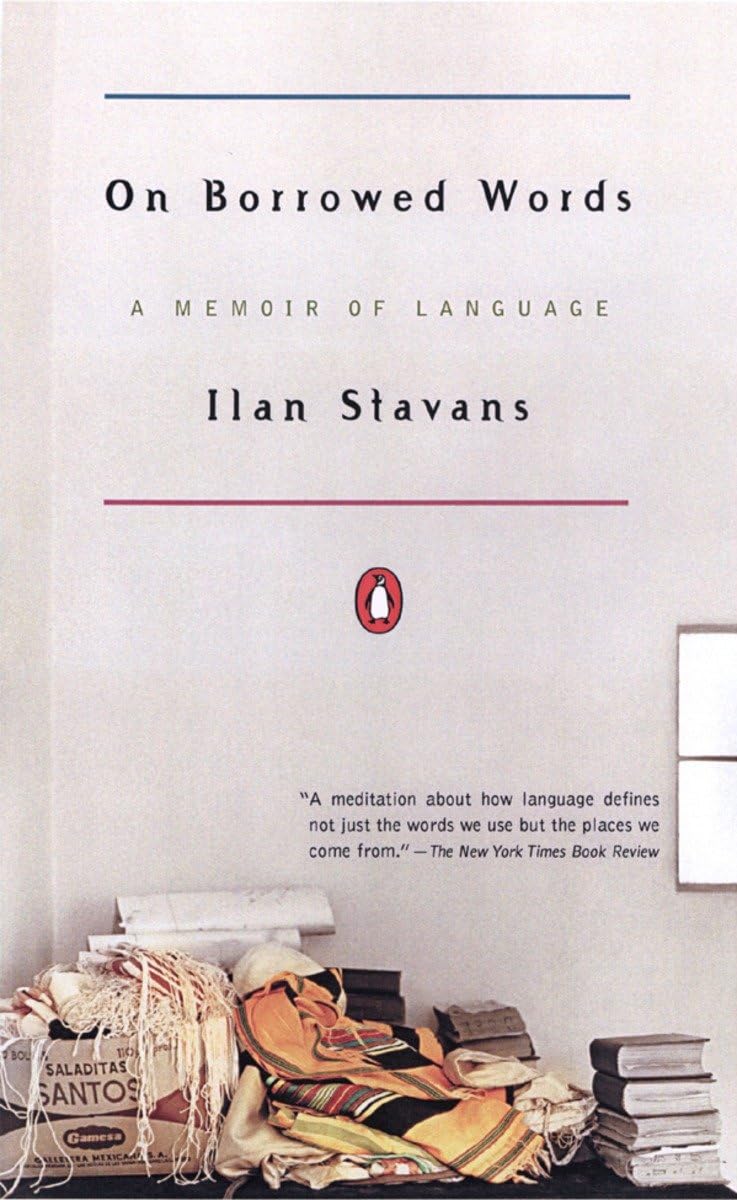
Yiddish, Spanish, Hebrew, and English-at various points in Ilan Stavans's life, each of these has been his primary language. In this rich memoir, the linguistic chameleon outlines his remarkable cultural heritage from his birth in politically fragile Mexico, through his years as a student activist and young Zionist in Israel, to his present career as a noted and controversial academic and writer. Along the way, Stavans introduces readers to some of the remarkable members of his family-his brother, a musical wunderkind; his father, a Mexican soap opera star; his grandmother, who arrived in Mexico from Eastern Europe in 1929 and wrote her own autobiography. Masterfully weaving personal reminiscences with a provocative investigation into language acquisition and cultural code switching, On Borrowed Words is a compelling exploration of Stavans's search for his place in the world. "A meditation on how language defines not just the words we use but the places we come from." — The New York Times Book Review "Stavans's Mexico . . . is a treacherous but vivid world seen through the eyes of a gifted child; his subsequent encounter with America makes the New World seem-astonishingly-new." James Atlas , author of Bellow: A Biography Ilan Stavans is Lewis-Sebring Professor in Latin American and Latino Culture at Amherst College and the author or editor of numerous books. Chapter One In order to enjoy life, we should not enjoy it too much. —VLADIMIR NABOKOV I am packing my library. I reach for the books, browse calmly through their pages, dust off the jackets, and proceed to store them in empty cartons. I will number these boxes from one to sixty. When the books come out again, I will arrange them in an altogether different order. Their overall setting will be different, too. There is a certain sweetness to the whole enterprise in which I am involved, for I realize how much my library and I have changed together this past decade. We began modestly and now we hardly recognize each other. Are all these volumes really mine? What do they say about me? And what can I, their collector, say about them? Suddenly, I don't know why but I recall an object from my childhood: la pistola —a small, antiquated pistol, .22-caliber. Books ... No, they hardly played a part in my childhood. I was an outdoor kid, hiking, collecting butterflies. Books symbolized passivity, a reluctance to act, to be part of the universe. I only began to fall for them in my late adolescence, when I realized how exciting the life of the imagination could be—as exciting, for sure, as any real adventure under the open sky. My library was nonexistent when I was seventeen or eighteen. Every volume my parents bought for me was relegated to a shelf I could hardly reach in my bedroom. Ah, but the pistol, la pistola ... Throughout my childhood I was obsessed by it. Why did my father keep it hidden in a safe-deposit box inside his closet? He would open this box on very rare occasions—to take a pair of earrings out, to deposit a gold necklace my mother inherited from my grandmother Bobbe Miriam, to make sure his pile of dollars was intact. While the door was open, I would glance at the pistol furtively, fearfully, from the corner of my eye, imagining all sorts of possible connections. Why on earth was it in my home? What was its real purpose? Who gave it to my father and why? Whenever I asked him, he would say, "I just like to keep it around. No particular reason, nothing to think about, really." But no reason to him was reason enough for a child like me to worry, and so I speculated about it. As a young man, his own father, Zeyde Srulek, I told myself, had used it during a pogrom in Eastern Europe. Or it was the remnant of an obscure, violent period in my father's life he had gone out of his way to conceal from me? That it was simply a defense weapon in case of burglary crossed my mind several times, of course, but I dismissed this explanation as too simple and unconvincing. I had recurrent dreams in which la pistola appeared: in the most haunting one, which I had around the age of ten, my father and I were members of an anthropological expedition to Chiapas. After crossing the high, primeval Lacandonian jungle, we came upon a system of caves in the mountains. Here, an Indian tribe had survived from time immemorial. My father talked to a priest, who invited us to a religious ceremony. We were taken to an immense central grotto with a pointed Gothic roof. A set of ancient rites unfolded before us, until the dream reached its climax. Fixed on the wall of the cave was a wooden bust in the shape of an immense head of a divinity; the head opened and closed its mouth; the priest told my father the head wanted me as a sacrifice; my father took the pistol out of a backpack, but instead of firing it, he put it right on the floor and smiled. Then he looked at me. "Don't worry, mi amor ," he said. "The pistol will satisfy their god's appetite." "How do yo