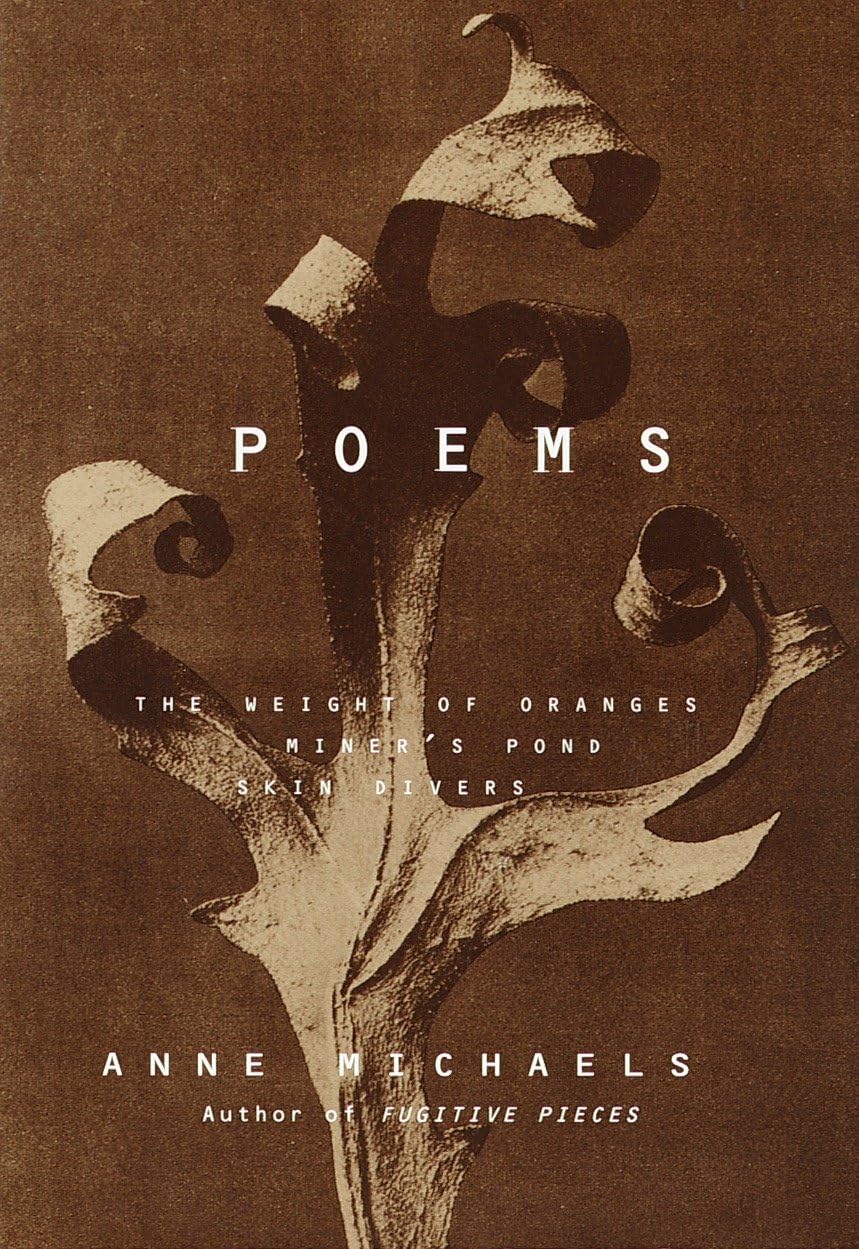
Prior to her stunning first novel, Fugitive Pieces , Anne Michaels had already won awards and critical acclaim for two books of poetry: The Weight of Oranges (1986), which won the Commonwealth Prize for the Americas, and Miner's Pond (1991), which received the Canadian Authors Association Award and was short-listed for the Governor General's Award and the Trillium Award. Although they were published separately, these two books, along with Skin Divers , a collection of Michaels's newest work, were written as companion volumes. Poems brings all three books together for the first time, creating for American readers a wonderful introduction to Anne Michaels's poetry. Meditative and insightful, powerful and heart-moving, these are poems that, as Michael Ondaatje has written, "go way beyond games or fashion or politics . . . They represent the human being entire." stunning first novel, Fugitive Pieces , Anne Michaels had already won awards and critical acclaim for two books of poetry: The Weight of Oranges (1986), which won the Commonwealth Prize for the Americas, and Miner's Pond (1991), which received the Canadian Authors Association Award and was short-listed for the Governor General's Award and the Trillium Award. Although they were published separately, these two books, along with Skin Divers , a collection of Michaels's newest work, were written as companion volumes. Poems brings all three books together for the first time, creating for American readers a wonderful introduction to Anne Michaels's poetry. Meditative and insightful, powerful and heart-moving, these are poems that, as Michael Ondaatje has written, "go way beyond games or fashion or politics . . . They represent the human being entire." Prior to her stunning first novel, Fugitive Pieces, Anne Michaels had already won awards and critical acclaim for two books of poetry: The Weight of Oranges (1986), which won the Commonwealth Prize for the Americas, and Miner's Pond (1991), which received the Canadian Authors Association Award and was short-listed for the Governor General's Award and the Trillium Award. Although they were published separately, these two books, along with Skin Divers, a collection of Michaels's newest work, were written as companion volumes. Poems brings all three books together for the first time, creating for American readers a wonderful introduction to Anne Michaels's poetry. Meditative and insightful, powerful and heart-moving, these are poems that, as Michael Ondaatje has written, "go way beyond games or fashion or politics . . . They represent the human being entire." Anne Michaels is the author of the best-selling novel Fugitive Pieces , which was translated and published in more than two dozen countries and won several awards, including the 1997 Lannan Literary Award for Fiction and, in Britain, the Guardian Fiction Award and the Orange Prize. She lives in Toronto. Ice House "I regret nothing but his suffering." --Kathleen Scott Wherever we cry, it's far from home. - At Sandwich, our son pointed persistently to sea. I followed his infant gaze, expecting a bird or a boat but there was nothing. How unnerving, as if he could see you on the horizon, knew where you were exactly: at the edge of the world. - You unloaded the ship at Lyttelton and repacked her: "thirty-five dogs five tons of dog food fifteen ponies thirty-two tons of pony fodder three motor-sledges four hundred and sixty tons of coal collapsible huts an acetylene plant thirty-five thousand cigars one guinea pig one fantail pigeon three rabbits one cat with its own hammock, blanket and pillow one hundred and sixty-two carcasses of mutton and an ice house." - Men returned from war without faces, with noses lost discretely as antique statues. accurately as if eaten by frostbite. In clay I shaped their flesh, sometimes retrieving a likeness from photographs. Then the surgeons copied nose, ears, jaw with molten wax and metal plates and horsehair stiches; with borrowed cartilage, from the soldiers' own ribs, leftovers stored under the skin of the abdomen. I held the men down until the morphia slid into them. I was only sick afterwards. Working the clay, I remembered mornings in Rodin's studio, his drawfuls of tiny hands and feet, like a mechanic's tool box. I imagined my mother in her blindness before she died, touching my face, as if she still could build me with her body,. At night, in the studio I took your face in my hands and your fine arms and long legs, your small waist, and loved you into stone. The men returned from France to Ellerman's Hospital. Their courage was beautiful. I understood the work at once: To use scar tissue to advantage. To construct through art, one's face to the world. Sculpt what's missing. - You reached furthest south, then you went futher. In neither of those forsaken places did you forsake us. - At Lyttelton the hills unrolled, a Japanese scroll painting; we opened the landscape with our b