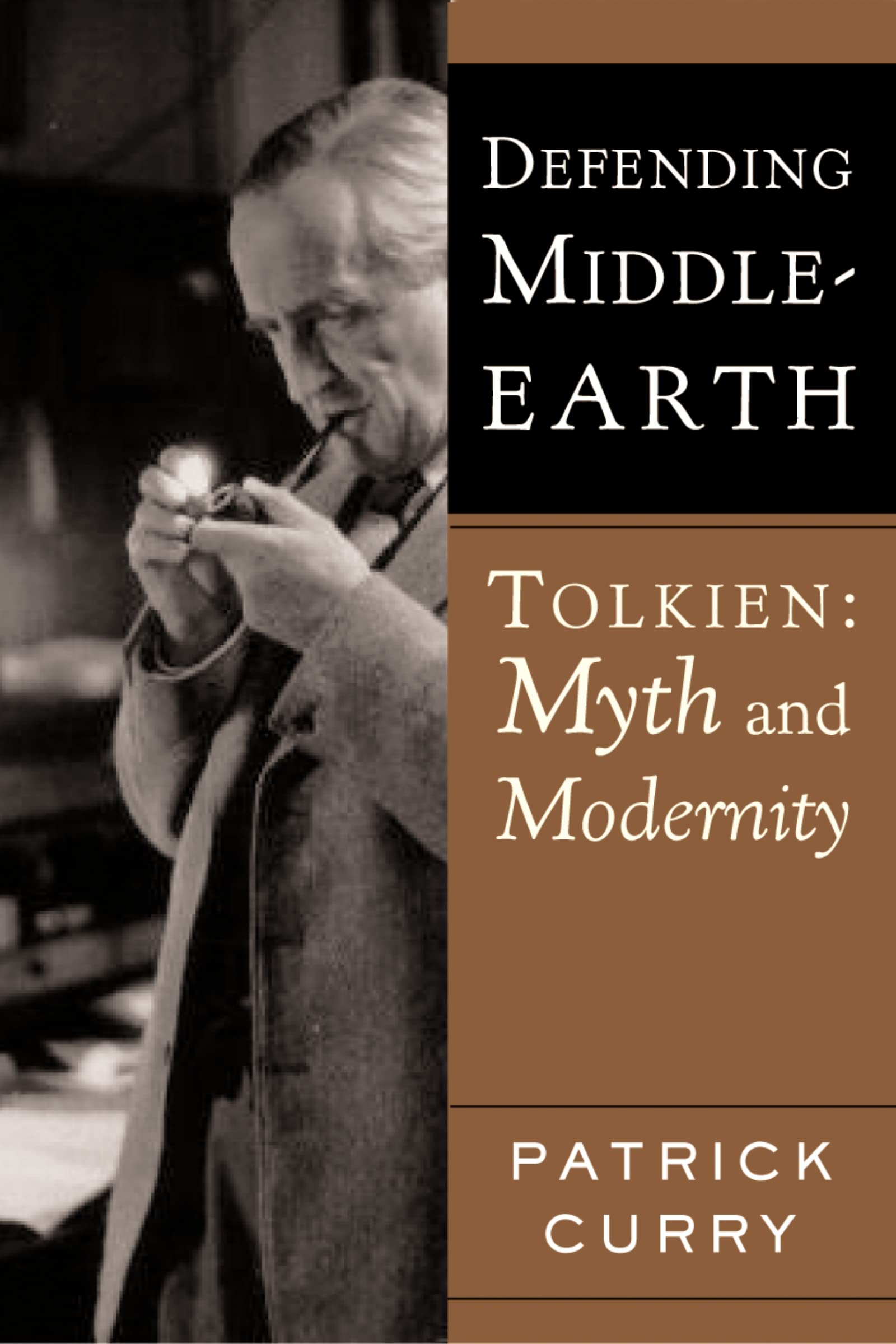
What are millions of readers all over the world getting out of reading The Lord of the Rings? Newly reissued with a new afterword, Patrick Curry's Defending Middle-earth argues, in part, that Tolkien has found a way to provide something close to spirit in a secular age. His focus is on three main aspects of Tolkien's fiction: the social and political structure of Middle-earth and how the varying cultures within it find common cause in the face of a shared threat; the nature and ecology of Middle-earth and how what we think of as the natural world joins the battle against mindless, mechanized destruction; and the spirituality and ethics of Middle-earth, for which Curry provides a particularly insightful and resonant examination that will deepen the understanding of the millions of fans who have taken The Lord of the Rings to heart. Ursula Le Guin has this to say about *Defending Middle-Earth*: "Though modernism defines fantasy as irrelevance, readers know better.... What Tolkien offers is 'hope without guarantees,' and Curry shows us how he does it. A most valuable and timely book." Tom Shippey says: "Curry sees deep into the spiritual heart of Tolkien's world, and explains it in clear and unaffected language. The shade of Tolkien would nod approval." David Abram says: "...this audacious little gem of a book: a luminous study of *The Lord of the Rings* and its growing relevance for our era." Patrick Curry, a Canadian-born writer and scholar, is a Tolkien expert featured on the extended DVDs of the films of The Lord of the Rings. He holds a Ph.D. in the history and philosophy of science and is the author of Introducing Machiavelli as well as several books and essays of social history. 1 INTRODUCTION: RADICAL NOSTALGIA People who like this sort of thing will find this the sort of thing they like. It could be a literary fairy-story. A reclusive Oxford don, best-known for his scholarly work on Anglo-Saxon, unexpectedly produces a popular children's story. Seventeen years later, he follows this up with a very long story, published in three volumes. Set entirely in an imaginary world, it centres on a quest involving a magic ring and some members of a three-and-a-half-foot-tall rustic race called 'hobbits.' His book is variously described as romantic epic or juvenile fantasy; but whatever it is, it is certainly not a modern novel, and the critics are divided between bafflement and visceral dislike. The general opinion in the academic and critical neighbourhood is that, rather like one of his characters, its author, 'who had always been rather cracked, had at last gone quite mad . . .' Yet just over ten years later, his books become runaway bestsellers; and after forty years, they count among the most widely read in the global history of publishing. The author is, of course, John Ronald Reuel Tolkien (1892– 1973). Born in South Africa to English parents, he moved back to England, just outside Birmingham, at the age of three-and-a-half. He developed a childhood passion for languages into a lifelong academic career, interrupted by service in the war of 1914–18. He became Professor first of Anglo-Saxon, then of English Language and Literature, at Oxford, where he remained for the rest of his life. Despite co-editing a respected edition of Sir Gawain and the Green Knight, and writing a paper on Beowulf acclaimed for its brilliance, it was an unremarkable life by many standards . . . except for those books. Reliable figures are hard to come by, but as far as I can tell, total worldwide sales of Tolkien's books are as follows. The Lord of the Rings (1954–55), at about 50 million copies, is probably the biggest-selling single work of fiction this century. The Hobbit (1937) is not far behind, at between 35 and 40 million copies. And one could add the considerable sales, now perhaps over 2 million, of his dark and difficult posthumously published epic The Silmarillion (1977). The grand total is thus well on its way to 100 million. Tolkien's books have been translated into more than thirty languages, including Japanese, Catalan, Estonian, Greek, Hebrew, Finnish, Indonesian and Vietnamese. (This last, unofficial translation appeared in 1967, whereupon the South Vietnamese II Corps was rather perceptively fêted by tribesmen with shields bearing the Eye of Sauron.) Furthermore, this is no flash-in-the-pan phenomenon, riding on the heels of the 1960s; Tolkien has outlived the counter-culture in which he first flourished. No longer fashionable, he nonetheless still sells steadily. That was undoubtedly the main reason for the purchase in 1990 of his publisher, Unwin Hyman (originally George Allen and Unwin), by HarperCollins. Every other index points to the same conclusion. In England, for example, since figures began to be kept in 1991, Tolkien's books have been taken out of public libraries around 200,000 times a year; he is one of only four 'classic authors' whose annual lending tota