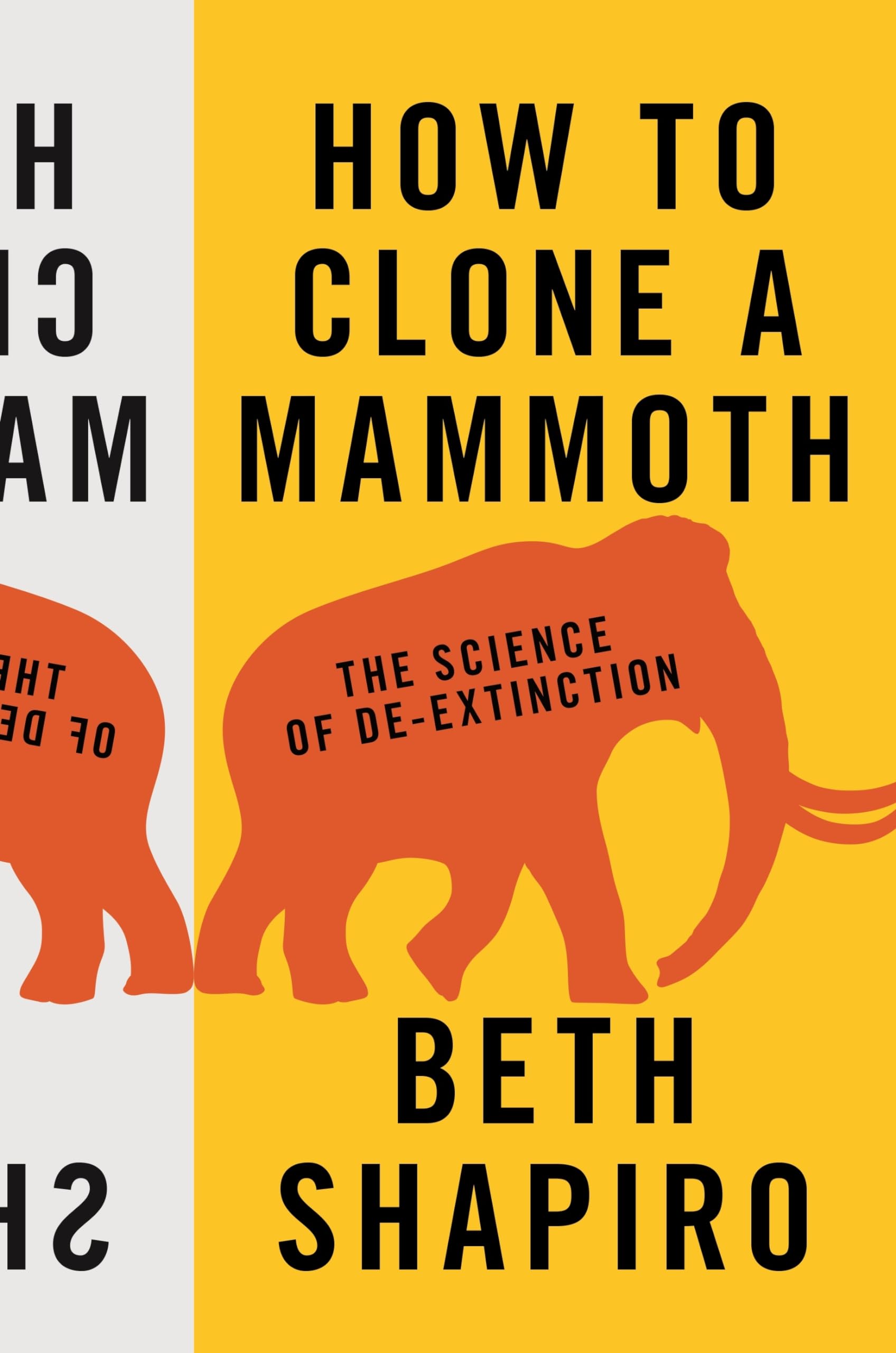
An insider's view on bringing extinct species back to life Could extinct species, like mammoths and passenger pigeons, be brought back to life? The science says yes. In How to Clone a Mammoth , Beth Shapiro, evolutionary biologist and pioneer in "ancient DNA" research, walks readers through the astonishing and controversial process of de-extinction. From deciding which species should be restored, to sequencing their genomes, to anticipating how revived populations might be overseen in the wild, Shapiro vividly explores the extraordinary cutting-edge science that is being used―today―to resurrect the past. Journeying to far-flung Siberian locales in search of ice age bones and delving into her own research―as well as those of fellow experts such as Svante Paabo, George Church, and Craig Venter―Shapiro considers de-extinction's practical benefits and ethical challenges. Would de-extinction change the way we live? Is this really cloning? What are the costs and risks? And what is the ultimate goal? Using DNA collected from remains as a genetic blueprint, scientists aim to engineer extinct traits--traits that evolved by natural selection over thousands of years―into living organisms. But rather than viewing de-extinction as a way to restore one particular species, Shapiro argues that the overarching goal should be the revitalization and stabilization of contemporary ecosystems. For example, elephants with genes modified to express mammoth traits could expand into the Arctic, re-establishing lost productivity to the tundra ecosystem. Looking at the very real and compelling science behind an idea once seen as science fiction, How to Clone a Mammoth demonstrates how de-extinction will redefine conservation's future. According to this book, the future of Shapiro's field, "ancient DNA," lies in adapting existing species to survive in threatened environments-think of an elephant refit with the woolly mammoth's coat, relocated in the Arctic tundra. Sounds fantastic, as in unbelievable: although de-extinction was the stuff of science fiction once, advances in genome research have made it more realistic than cloning, the author argues. Many of her colleagues have tried- and failed-to bring back the bucardo, the dodo, the moa, the Lazarus frog, and the carrier pigeon, to name a few whose stories Shapiro honors simply by retelling them. This eye-opening narrative will give teens an inside look at the various facets of scientific research: discipline, ambition, imagination, disappointment, and danger. For example, in 2007 Japan, a 42,000-year-old baby mammoth-so well preserved that "her stomach still contained traces of her mother's milk"-excited researchers, who immediately named her Lyuba. But her DNA was useless, and so their endeavor was short-lived. The future, Shapiro believes, is in de-extinction, which alters existing species in the name of preservation and which, she acknowledges, carries a heavy responsibility in itself. The nonfiction work's 16 color plates and illustrations throughout add to its appeal. VERDICT For students who are interested in environmental issues, who like animals, or who think science is "boring," this book is pretty irresistible.-Georgia Christgau, Middle College High School, Long Island City, NYα(c) Copyright 2011. Library Journals LLC, a wholly owned subsidiary of Media Source, Inc. No redistribution permitted. "Winner of the 2016 PROSE Award in Popular Science & Popular Mathematics, Association of American Publishers" "2016 Gold Medal Winner in Science, Independent Publisher Book Awards" "Winner of the 2016 AAAS/Subaru SB&F Prize for Excellence in Science Books, Young Adult Science Books" "Shortlisted for the 2016 Phi Beta Kappa Award in Science, Phi Beta Kappa Society" "One of The Independent’s 6 Best Books in Science 2015" "Finalist for the 2015 Los Angeles Times Book Prize in Science & Technology" "One of Flavorwire’s 10 Must-Read Academic Books for 2015" "One of NewScientist.com CultureLab’s Best Reads from 2015" "One of Science News’ Favorite Books of 2015" "Beth Shapiro . . . has produced a fascinating book. . . . For anyone who wants a thorough understanding of the technical issues involved in de-extinction, How to Clone a Mammoth should satisfy your curiosity." ---Carl Zimmer, Wall Street Journal "Shapiro . . . Lays out a well-articulated argument for the ‘resurrection of ecological interactions' as the most appropriate goal of de-extinction research. . . . Her professorial voice shines in her thoughtful roadmap for practical decision making in theory-heavy science, as well as in her efforts to 'separate the science of de-extinction from the science fiction of de-extinction.' Readers will emerge with the ability to think more deeply about the facts of de-extinction and cloning at a time when hyperbolic and emotionally manipulative claims about such scientific breakthroughs are all too common." ― Publishers Weekly "[A] disturbing and thoughtful new book. . .