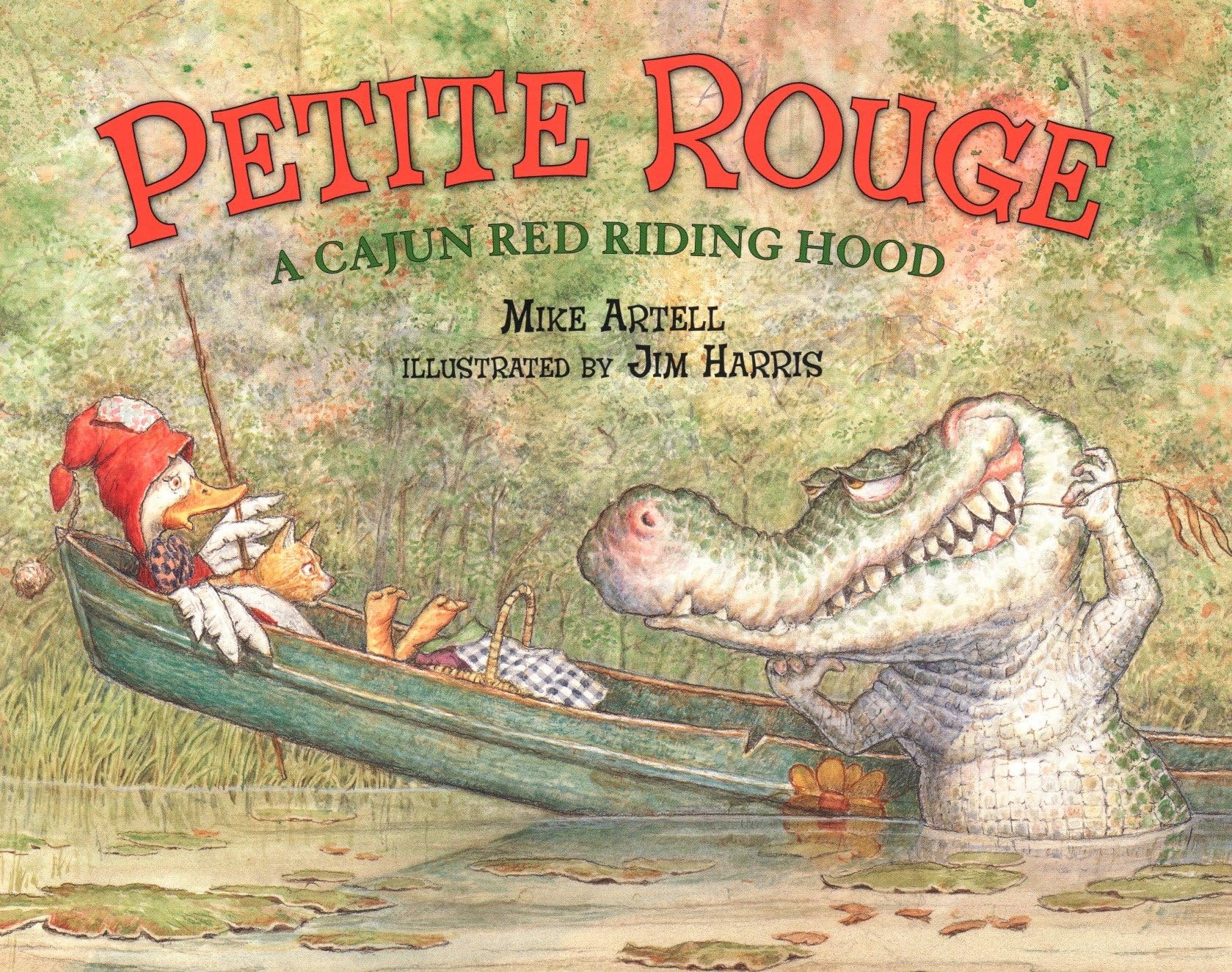
Big Bad Gator Claude will do anything to have a taste of Petite Rouge...even if it means putting on a duck bill, flippers, and frilly underwear. He presents no match for the spunky heroine and her quick-thinking cat TeJean, though, as they use some strong Cajun hot sauce to teach Claude a lesson he will never forget! The combination of hilarious rhyme and exaggerated art creates a highly original retelling of the classic fairy tale. A pronunciation guide/glossary accompanies a tempting dialect that begs to be read aloud or acted out again and again. This is Little Red Riding Hood as she's never been seen before: Cajun and ducky. Gr 1-3-A wonderful, sly, and humorous story told in rhyme and illustrated with verve. Artell avoids the temptation to throw in too many unfamiliar words, and places the handful of definitions for the Cajun terms he does use in a glossary at the beginning. The amusing verse scans well; the watercolor-and-pencil illustrations teem with details of Cajun life and add immeasurably to the fun. Petite Rouge is a goose in this version, with a perky cat, TeJean, for a companion. Readers are challenged to find a little mouse that appears in each picture and watches all of the goings-on. Of course, instead of the big bad wolf, there is Claude, "dat ol' gator," who frightens Grand-mre into a closet and dons her clothing. When Rouge and TeJean notice Grand-mre's huge teeth and realize they're in trouble, they throw a boudin (sausage) drenched in hot sauce into the villain's mouth, which does the trick. Claude, who thinks he has eaten Petite Rouge, jumps into the swamp to cool off. The last illustration shows him still dressed in Grand-mre's pajamas, lying by his cypress tree, with signs all around him that say: "Don' feed dis gator." The text explains, "Ol' Claude reckon people/be too hot to eat./He don' know dat de hot sauce/done made all de heat." All in all, a treat from start to finish. Judith Constantinides, formerly at East Baton Rouge Parish Main Library, LA Copyright 2001 Cahners Business Information, Inc. Reviewed with Sheila Hebert-Collins' 'T Pousette et 'T Poulette . Ages 3-7. Set in the heart of the Louisiana swampland, Petite Rouge blend lots of Cajun French language and culture into the lively storytelling. In Artell's funny, rhyming takeoff of "Little Red Riding Hood," the wolf is an alligator, and Petite Rouge is a sturdy young duck who doesn't need a woodcutter to rescue her. The alligator wants to have her for lunch, but she threatens him, "Dis pole gonna hit you / where you part your hair." With the help of her smart cat, she tricks the predator, and then she and Grand-mere sit down to a Cajun feast. Even older children will enjoy the mayhem and the parody, including the paintings in Grand-mere's house of solemn duck versions of the American Gothic and the Mona Lisa . There's a brief note on Cajun history and a glossary, but a storyteller familiar with the language will easily manage. Harris' wonderful watercolor-and-pencil pictures are filled with action and playful detail that extend the story. They make the alligator both scary and ridiculous--huge teeth and frilly nightgown are a perfect combination. Hazel Rochman Copyright © American Library Association. All rights reserved "Lyrical and visually hilarious." - Kirkus Reviews My mom and dad were both raised in Southwest Louisiana and I grew up (and still live) in the New Orleans area so I heard a LOT of Cajun stories growing up. After seeing the Cajun Night Before Christmas many years ago, it occurred to me that no one had done other traditional folk tales with a Cajun twist. So I wrote PETITE ROUGE, THREE LITTLE CAJUN PIGS and JACQUES AND DE BEANSTALK. I also did audio recordings (do a YouTube search on my name) of me reciting the books. Mike Artell is an award-winning children's book author, illustrator and television cartoonist. Mike's books include nationally recognized lift-the-flap board books for small children and non-fiction books for older children. Mike has also written and illustrated teacher and parent resource books on subjects as diverse as ecology, parties, drawing and young authorship. In addition to his work as an author and illustrator, Mike also has extensive experience as: · A musician who plays guitar, bass, keyboard and blues harmonica. · A storyteller who regularly performs original poems and tales. · A newspaper editorial cartoonist. · A magazine and greeting card writer and cartoonist. · A keynote speaker for major educational conferences. · A marketing consultant/board member for several high technology companies. · The host of his own television cartooning show. Each year, Mike shares his books and his writing/drawing techniques with thousands of students at dozens of schools across the country. During that same year, Mike typically writes and illustrates 2 books, conducts 6 teacher workshops, addresses 10 educational conferences and visits 6 libraries or children's museums. Mike a