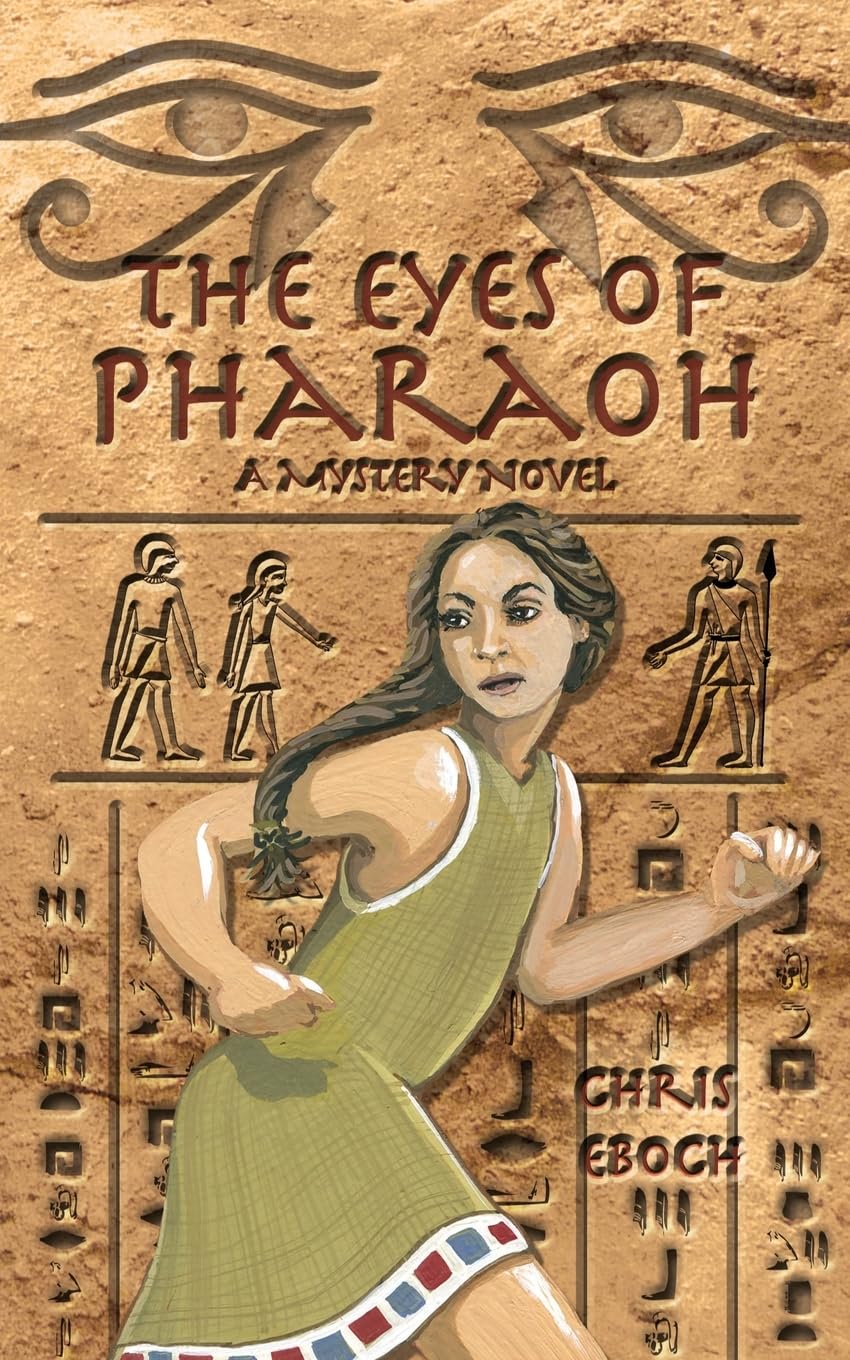
"Ancient Egypt comes to life in this thrilling mystery" "Intriguing, vivid historical mystery" "You'll feel like you're there" "Exciting, educational, engaging" "Five stars" 1177 BC: During the reign of Pharaoh Ramses the Third, Seshta, a 13-year-old dancer in the Temple of Hathor, dreams of becoming a famous entertainer. Horus, the brother of her heart, is content as a toymaker’s apprentice. Reya, at 16, has joined Egypt’s army with hopes of becoming a hero. When Reya hints that Egypt is in danger from foreign nomads, Seshta and Horus don’t take him seriously. How could anyone challenge Egypt? Then Reya disappears. Seshta and Horus set out to find him—and discover a darker plot than they ever imagined. To save their friend, Seshta and Horus spy on merchants, soldiers, and royalty, and start to suspect even The Eyes of Pharaoh, the powerful head of the secret police. Will Seshta and Horus escape the traps set for them, rescue Reya, and stop the plot against Egypt in time? Set in ancient Egypt, the ideas in this book resonate today, while the power of friendship will touch hearts both young and old. Suitable for ages 9 and up. Praise for the Eyes of Pharaoh: "Likable characters and some surprising plot twists keep you wanting to know what will happen next....fast paced mystery that has so much history and culture hidden in plain sight…. You won't be able to put the book down until you learn what happens to the three friends." "I teach a gifted class of fourth and fifth graders. Using this historical fiction has been a window into Ancient Egypt—its people, culture, and beliefs. My class enjoyed doing research on Egyptian gods and goddesses, and hieroglyphs. Projects extended their knowledge of this fascinating time and place. I also highly recommend it for its fast paced plot, interesting and "real" characters, and excellent writing." "...exciting action with interesting characters, a brisk plot line and historically-accurate details of the book's setting." "... An intriguing mystery embedded within a book full of beautiful writing.... Evocative descriptions which make you feel like you're right there, running through the markets with Seshta or sitting by the river watching the fishermen." "...fast paced plot, interesting and "real" characters, and excellent writing." Chris Eboch is the author of over 100 books for children, including nonfiction and fiction, early reader through teen. Her novels for ages nine and up include The Well of Sacrifice , a Mayan adventure; The Genie’s Gift , a middle eastern fantasy; and the Haunted series , about kids who travel with a ghost hunter TV show, which starts with The Ghost on the Stairs . Her writing craft books include You Can Write for Children: How to Write Great Stories, Articles, and Books for Kids and Teenagers, and Advanced Plotting . Chris also writes mystery, suspense, and romance for adults under the name Kris Bock: www.krisbock.com. One of the earliest civilizations in the world arose in Egypt over 5000 years ago. The pharaohs ruled Egypt for 2500 years--but not without challenges. Ramses the Third ruled during the New Kingdom, the golden age of Egypt. At that time, the great pyramids were already a thousand years old. Egypt remained the first and greatest superpower of the world, a land of plenty with rich fields fed by the annual Nile floods. Foreigners flocked to Egypt as immigrants and traders, seeking a better life. But when Egypt closed its borders to foreigners facing famine at home, resentment sometimes turned to violence. In his 30 years as Pharaoh, from about 1184 to 1153 BC, Ramses had to defend the borders at least three times from foreign invaders. These included the Libu, a tribe from the area that is now Libya. His military also traveled to distant lands to meet foreign enemies. At home, Ramses faced threats from the priesthood, a workers' strike at the royal necropolis, and even a palace murder plot. The story of Seshta, Horus, and Reya is set during this time. Other than Ramses the Third, all characters and events are fictional, yet their lifestyles and attitudes are based on what we know of ancient Egypt. The Eyes and Ears of Pharaoh was a real position at the head of Egypt's secret police. Young dancers performed at parties or worked in the temples. An ambitious young man might join the military, hoping for advancement. A poor boy might feel lucky to work as an apprentice toymaker. Religion was part of everyday life, but individual devotion varied, and most people had a favorite god or goddess from among the large pantheon that watched over Egypt. (Seshta takes her name from the goddess of learning.) People believed the ba , part of the soul, traveled at night in dreams. I have tried to reach across the millennia and capture life in ancient Egypt. Most of all, these characters were created with the belief that in every culture, throughout history, people are motivated by the same emotion