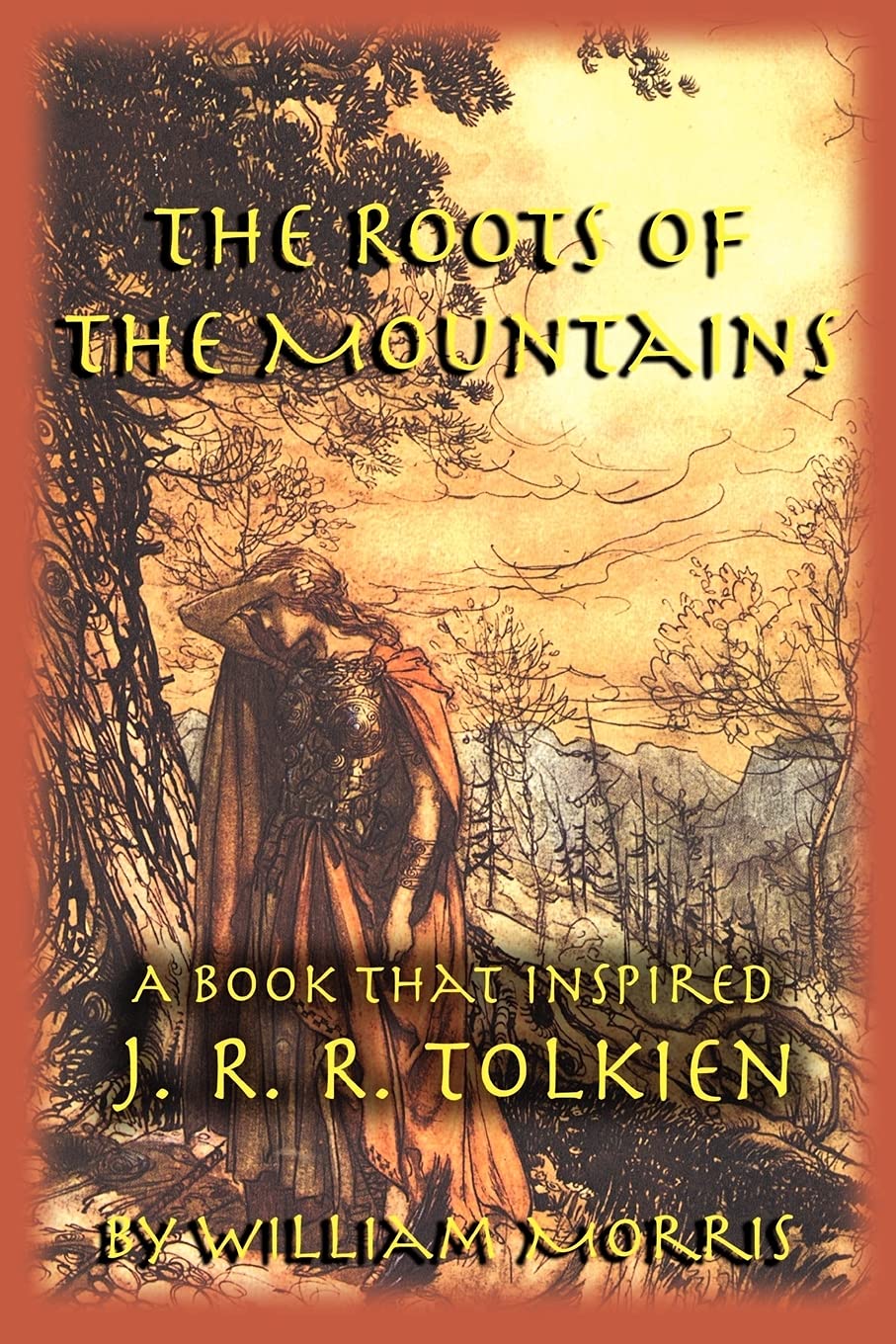
J. R. R. Tolkien's The Lord of the Rings was influenced by this tale of a romance that unites two long-ago peoples and of the battle to defend their freedom against invading Huns. This book is part of a series of inexpensive books intended to make better known the writings of William Morris and his influence on J. R. R. Tolkien. Books in the series include: More to William Morris, which contains Morris' two great tales of herorism and battle, The House of the Wolfings and The Roots of the Mountains. Both books are also available separately in hardback and paperback. On the Lines Morris' Romances, which contains Morris' two great quest romances, The Wood Beyond the World and The Well at the World's End. Both books are also available separately in hardback and paperback. Do an Internet web search for "William Morris" and you'll find dozens of matches for this talented nineteenth English artist, poet and writer. Combining the ancient tales of northern Europe he loved so much with folk tales and writing them as a modern novel, William Morris (1834-1896) pioneered modern fantasy literature and influenced books such as J. R. R. Tolkien's The Lord of the Rings. From the Foreword In her introduction to the fourteenth volume of The Collected Works of William Morris (1912), Morris' daughter May said that, "In The House of the Wolfings and in The Roots of the Mountains my father seems to have got back to the atmosphere of the [ancient Northern European] Sagas. In that it is part metrical, part prose, the Wolfings may be held experimental, but in this tale of imaginary tribal life on the verge of Roman conquest a period which had a great fascination for the writer, who read with critical enjoyment the more important modern studies of it as they came out." The impact of those "modern studies" must have been great, for May Morris went on to note with amusement, a "German professor who, after the Wolfings came out, wrote and asked learned questions about the Mark, expecting, I fear, equally learned answers from our Poet who sometimes dreamed realities without having documentary evidence of them." The hot-tempered Morris' own response to that professor was amusing. "Doesn't the fool realize," he shouted, "that it's a romance, a work of fiction that it's all lies!" As Morris well knew, we know almost nothing the day-to-day life of these brave and intelligent, but typically illiterate Central and Northern European tribes. In the Middle East, a dry climate, the widespread use of stone and clay, and the early spread of a written language preserved much. In a region that J. R. R. Tolkien would also make such a prominent part of his Middle-earth, a wet climate, the limited use of writing, and the common use of wood and leather left little for future generations to study. What little we do know has as its source the far from objective remarks of foes, such as the Romans, and literary fragments that have come down to us across the centuries, preserved in poetic sagas about great heroes and their accomplishments. Both Morris and Tolkien drank deeply from those ancient literary wells of "Northerness." Morris did so as part of a broad artistic genius that included the translation of ancient tales such as his 1870 Volsunga Saga: The Story of the Volsungs and Niblungs. Tolkien did so as part of his professional life as an Oxford professor and a leading expert on the ancient languages and literature of Northern Europe. These two men knew either much (Morris) or most (Tolkien) of all that was known about these people and their lives. They used that wealth of knowledge to create "dreamed realities" (Morris) or an "imaginary history" (Tolkien) about what it might have been like to live in those days. While what they wrote wasn't necessarily true in a strict sense, both knew enough about the past and were talented enough as writers that what they wrote creates a strong sense that they describe what might have been. Their readers certainly sense this. One wrote Morris that his tales, "convey the impression of your having lived in the time to describe what you have seen." The effect of Tolkien is even more startling. Friends of his fans often complain that those who drink deeply of Middle-earth act as if Tolkien's created world were more real than the one in which they live. In his Rehabilitations, Tolkien's close friend C. S. Lewis said much the same when he noted of Morris, "All we need demand is that this invented world should have some intellectual or emotional relevance to the world we live in. And it has." Without a doubt, both Morris and Tolkien achieved that most difficult of all tasks for an author. They imagined a world with such skill that those who inhabit it seem as real as our next-door neighbor. Morris made clear that was his intent in a July 1889 paper in which he discussed romantic literature and said that, "As for romance, what does romance mean? I have heard people miscalled for being romantic, but what romance mea